

Karsa Orlong
-
Posts
7,149 -
Joined
-
Last visited
Content Type
Profiles
Forums
Events
Books
Posts posted by Karsa Orlong
-
-
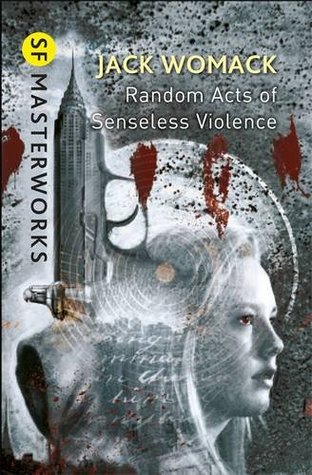
Random Acts of Senseless Violence by Jack Womack
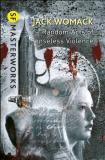
1993 - Gollancz ebook - 256 pages
It's just a little later than now and Lola Hart is writing her life in a diary. She's a nice middle-class girl on the verge of her teens who schools at the calm end of town.
A normal, happy, girl.
But in a disintegrating New York she is a dying breed. War is breaking out on Long Island, the army boys are flamethrowing the streets, five Presidents have been assassinated in a year. No one notices any more. Soon Lola and her family must move over to the Lower East side - Loisaida - to the Pit and the new language of violence of the streets.
The metamorphosis of the nice Lola Hart into the new model Lola has begun...Written in the form of a diary, Random Acts of Senseless Violence is the story of 12-year-old Lola Hart. She has loving parents and a sister, they live in a nice apartment in a near-future New York, and she goes to a private girls' school where she bitches and moans about boys with her friends, questions her sexuality, and goes through all the growing pains you would expect. So far, so ho-hum.
But this is a world in the midst of economic and societal meltdown, and what drew me inexorably into Lola's world is the way in which Womack so quietly works the detail into the story. It starts out like you would expect any kid's diary to start, with regular English and punctuation, the odd mistake or odd word choice but the sort of thing you could read in your sleep. In the background, occasionally mentioned, there is rioting on the streets, martial law, and palls of smoke constantly hanging over the city. As her parents fall towards financial oblivion the family is forced to move to a rougher end of town, and Lola's life begins to change, as do her diary entries. The language changes, subtly, over time. What was straightfoward English gradually becomes increasingly laced with street slang, the rhythm of dialogue changes, the punctuation all but disappears, and as anarchy takes hold of the streets so it takes hold of Lola's life.
It's this descent into anarchy that makes the book so compelling, because it's so organic and so seamlessly worked into the diary form that you don't at first realise that it's happening. It's superbly done. Does it qualify as science fiction? Well it's dystopian fiction, for sure, and much of the best SF holds up a mirror to our own society, and this book does that in spades, so I'd say it's a resounding 'yes'. If I had one gripe (and it is just a gripe) it's that it was fairly obvious what was coming at the end long before it actually got there but, in this case, I'd say it worked to effectively build tension to that point. It's a book that I found unsettling and surprisingly scary, populated by vivid, convincing characters who I genuinely cared about. It's a story with a message - and a warning. I'm amazed that it's not more widely lauded.
Memorable Quotes:
You don't know who your friends are ... until you're not like them anymore.
-
Normal thrones are boring, you can't strike fear into your mystical kingdom with a normal throne.

Oh I don't know - I've see a fair few porcelain thrones in pub bogs that would put the fear of God into an atheist

-
Cool. I've had that on my TBR pile for ages. Have you read anything else by Womack?
No, 'tis my first. Of course, when I bought it I didn't realise it was part of a series

 Although I think they're only loosely connected, is that right?
-
Does anyone in these books have a normal throne anymore? Skull Throne, Iron Throne blah blah blah
-
Currently 170 pages into Random Acts of Senseless Violence by Jack Womack. Might finish it today, more likely tomorrow.
-
Thanks, yeah I picked it up in the daily deal too. 99p well spent! Hope you enjoy it when you get to it

-
I actually thought of you when I wrote that part.
Perv

Well, you and your best mate Bob.
Oi, leave my BFF out of this - he writes fine novels that do not contain magic 'systems' or thinly-veiled attempts to foist his religious beliefs on the unsuspecting reader at all. Nope.
-
That's the best review I've ever read on here I think, Laura
 Must've taken you ages
 In this day and age, where works of fantasy are too often judged by how fastidious and logical their magic rules and ‘systems’ are, I can’t stress how refreshing it is to read a work instead suffused with nebulous magic, myths and legends, where the limits and possibilities and, indeed, reasons for magic are largely unknown.
Yes!!! I've always thought magic should be, well, magical. Can't bear all these frelling magic 'systems'

-
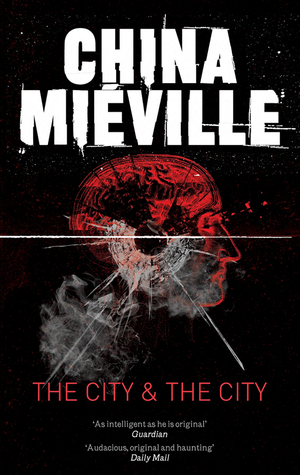
The City and the City by China Miéville
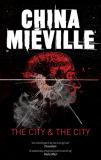
2009 - Pan ebook - 373 pages
There may be one or two people here who might remember that I regularly mention China Miéville's Perdido Street Station when one of those recommendation threads comes up. It is a weird, dark, violent, scary, and gothic novel quite unlike anything else I've read. So it has amazed me that it's taken so long for me to get back to his work. I even nearly abandoned this one about 80 pages in, purely because I got the urge to read some C J Cherryh. I'm so glad I didn't.
The City and the City, at its heart, is a murder mystery. Tyador Borlú is an Inspector for the Extreme Crime Squad in the city state of Besźel (weirdly, the Kindle edition misses out the 'ź' throughout
). Besźel is no ordinary city, though, because it is merged, intertwined, tangled with the city of Ul Qoma, occupying the same time and space as that city (quite how this happened is never really explained, apart from mention of the 'Cleaving'), with border controls and people on either side of that border having to 'un-see' those on the other side for fear of 'breaching' - interacting with the other side illegally, effectively - which will see them taken by the Breach themselves, a mysterious organisation that polices the borders and has the occupants of both cities living in fear. When an unidentified woman's body is found in a derelict skatepark it leads Borlú on an investigation that rapidly spirals out of control when he discovers that she was murdered in Ul Qoma but dumped in his own city.Besźel and Ul Qoma seem to exist somewhere between Eastern Europe and the Middle East, and you can see the subtexts Miéville is working in there (particularly towards Israel and Palestine, or perhaps Berlin before the wall came down), but he is not heavy-handed with it, and rarely strays from the mystery that is central to his story.
At a little under 400 pages, The City and the City is just about perfect in length. It's a taut, pacey read that I thought was executed to just about perfection. He's created a set of rules for the two cities and Breach that he adheres to throughout. The idea of 'un-seeing' and 'un-hearing', of areas that are 'alter' or 'cross-hatched', seem a bit confusing at first but they soon become second nature. And his characterisation is fantastic. The story is told in the first person, from Borlú's point of view, and he's joined by Ul Qoman detective Qussim Dhatt, and the hilariously foul-mouthed Bes policewoman Lizbyet Corwi. They occupy a truly unique, noir-ishly atmospheric setting and a beautifully constructed story that works on many levels. I'm going to miss all of them. I found it a thrilling, haunting novel from a wonderfully vivid imagination.
Quite brilliant.
Memorable Quotes:
Someone stood in the doorway. Light behind him, he was a cutout of darkness, a lack. When he stepped forward he was a man fifteen or twenty years my senior. To ugh and squat, in clothes as vague as my own. There were others behind him: a woman my own age, another man a little older. Their faces were without anything approaching expressions. They looked like people-shaped clay in the moments before God breathed out.
'Have you read Between the City and the City?' I said.
'When I was an undergrad, sure. My cam-cover was The Wealth of Nations.' During the 1960s and '70s some banned literature could be bought bound in stripped covers of legal paperbacks. 'What about it?'
'What did you think?'
'At the time, that it was amazing, man. Plus that I was unspeakably brave to be reading it. Subsequently that it was ridiculous. Are you finally going through adolescence, Tyador?'
'Could be. No one understands me. I didn't ask to be born.'
-

Well it's the last time, which is just as well, cos it's getting Big Money, and I should really Leave That Thing Alone, otherwise I might end up Losing It all
-
Not a cliffhanger, as such. You can just sense that the story's opening up.
-
Foreigner (Foreigner Book #1) by C J Cherryh
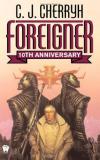
1994 - DAW paperback - 428 pages
The first book in C.J.Cherryh's eponymous series, Foreigner begins an epic tale of the survivors of a lost spacecraft who crash-land on a planet inhabited by a hostile, sentient alien race.
Well here's a surprise: on my mission to finish some of the series I already have on the go I suddenly decided to do . . . what? Start another series?? Bloody hell!
Although that's not strictly true, I suppose. I first started to read Foreigner last year. I got about a hundred pages in and just wasn't getting into it - the tight third person perspective and introspection wasn't what I wanted or needed at the time. So I put it to one side to return to at a later date, figuring that - as usual, and despite having bought the first three books in the series - it'd probably never happen.
Then last week I suddenly got the urge to read some Cherryh and, instead of choosing one of her more stand-alone novels or even the omnibus edition I have of her Morgaine Saga, I decided to pick this one up again - and it just happens to be the first book of her longest series (currently standing at sixteen books)
On the plus side the series breaks up into trilogies, so my plan is to read the first trilogy and see how it goes. On the negative, most of the books currently aren't available on Kindle in the UK, so it could potentially take up a lot of shelf space. And they have crap covers. Oh well.
Anyway, um, oh yes: the book itself!
Well, this time I was in the right mood for it, and I thoroughly enjoyed it. I understand and agree with a lot of the criticism of it, particularly with regard to repetition. For almost the entirety of the novel we are exclusively inside the main character's head, and it does seem that he goes through the same thoughts and thought processes quite regularly. If I hadn't been in the right mood, as with my aborted attempt to read it last year, this would have probably irritated and bored me. However . . . What I discovered this time was that it all fed in to the main character's paranoia. To fill in a bit, the novel begins with two short 'books' or what I would call prologues, totalling about 70 pages, which tell of a human spacecraft which is heading out to the borders of known space to set up a base in a commodity-rich, recently-discovered area. Something goes wrong. They go astray and end up somewhere else, they know not where. Jump forward a hundred years or so and they have made it to an unknown star system suitable for life and have recently landed on a planet there, where they are about to make first contact with an alien species, the atevi. And then it jumps forward another hundred and fifty years and the main story begins, introducing the main character, Bren Cameron, who is the Paidhi - or translator - and the only human living amongst the atevi, and is living in fear for his life, as some faction within atevi society wants him dead. He is alone, cut off, and he makes the mistake of attributing human thoughts and feelings to these aliens who neither think nor feel as humans do, and who have fourteen words for betrayal but not one for trust. Hence the paranoia and, once I understood that and got into Bren's mind, it worked really, really well.
Foreigner is not big on action, although there is some. It's more a sociopolitical examination of culture clash. Cherryh's writing style is engaging and she wants the reader to think about what Bren is dealing with, deliberately leaving some aspects vague enough that there were several lightbulb moments when I worked it out. That's part of the repetition, too - Bren keeps going back over things, working it out for himself as I worked it out for myself. Sometimes he seems a bit whiny but generally Cherryh's characterisation is some of the best I've come across in science fiction.
I'd say this is a very good book that does a lot of groundwork and worldbuilding. The atmosphere is oppressive but there's a brilliant revelation towards the end that opens things up beautifully. And this blurb from Goodreads is just too enticing for me not to want to read more:
From its beginnings as a human-alien story of first contact, the Foreigner series has become a true science fiction odyssey, following a civilization from the age of steam through early space flight to confrontations with other alien species in distant sectors of space. It is the masterwork of a truly remarkable author.
-
-
-
Watched an episode of The Musketeers last night and have had the theme music stuck in my head all morning
-
Most importantly (for me!), Agent Carter has been renewed for a second season. Along with The Flash it's been my favourite show this year. Hurrah!
-
Edge of Tomorrow. Surprisingly not as crap as I was expecting
Plus, Emily Blunt 
-
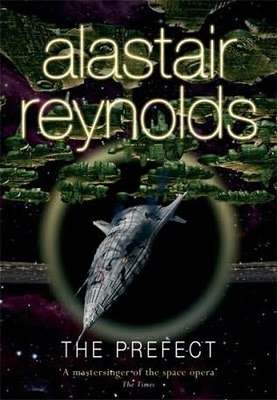
The Prefect by Alastair Reynolds
2007 - Gollancz ebook - 512 pages
A rollercoaster ride through the dark and turbulent universe of REVELATION SPACE: an interstellar thriller where nothing - and no one - is what they seem ...
So this is (currently) the last of the Revelation Space novels by Alastair Reynolds. It is a stand-alone story, and it is a prequel.
At its heart The Prefect is a detective story. Reynolds has taken the beating heart of a noir-ish crime thriller and twisted it kicking and screaming into this wonderfully deep and rich backdrop he has created. Chasm City also fit this bill, to a degree, and he also did similar with Century Rain, which is one I have yet to read, so he has an obvious fascination with if not the Sam Spades and Philip Marlowes of this world then at least the atmosphere and feel of the genre.
It begins with a mass murder. A habitat, home to over nine hundred people, is torn apart by a weapon of some sort. Tom Dreyfus, a Prefect (effectively a police detective), is sent to investigate. He finds that no-one is left alive, the only clue an unusual, half-finished sculpture, and an indication that the destruction was caused by a Conjoiner drive - the engines that power the huge Lighthugger spaceships belonging to the Ultras, the infamous part-human-part-machine spacefarers. Meanwhile, his subordinate Thalia Ng is sent to four other habitats to fix a bug in the polling software. Every governmental decision in the Glitter Band (Don't. Just. Don't
) - a ring of thousands of habitats in space around the planet Yellowstone, home to Chasm City itself - is made by polling the populace. Someone has found a way to exploit it and Thalia heads off to put this right. Needless to say, these two plot threads are not quite as separate as they appear, but they serve to make The Prefect a much more straightforward read than Reynolds' usual fare. The book does not suffer for it: it is streamlined, thoughtfully constructed, and has excellent characters. Reynolds' books usually start slow and then, as the various plotlines converge, start to snowball. This one's slightly different in that it maintains a solid pace throughout. What is perhaps more surprising is that he abandons his usual flare for the epic and makes this a much more intimate affair. It doesn't 'wow' in the way his other books often do - and there was no point where my jaw hit the floor like it did during Chasm City, Redemption Ark or House of Suns - but there are still plenty of twists and - ahem - revelatory moments, and a wonderfully downbeat ending.
I guess the main question is whether or not it can be read in isolation from the rest of the Revelation Space series. That's a hard one for me to judge, but I do feel it probably gained extra depth from having a foreknowledge of what is going to happen in these people's future. But I also think it works as a separate entity, so it might be worth a look for those new to Reynolds, although I'd still recommend Chasm City as a starting point. Nevertheless, The Prefect is a brilliant book. Highly recommended.
-
"Inspissated" - try saying that one when you're pi$$ed. Bet you'd sound like a right cuddy.
I would not!
 I might be a bit atrabilious, though
 -
Dances with Smurfs. Er, I mean Avatar: Collector's Edition Extended Cut. I'm still generally ambivalent about the story, but as a demo disc for my new tv (the old one broke after 8 years of valiant service
 ) and AV receiver (the old one was 16 years old) it is absolutely jaw-dropping
  There was lots of 'oh wow look at that!' and then ducking as sound effects whizzed past my shoulder
 X-Men: Days of Future Past. Not bad, but I was generally distracted by fiddling with the settings on the receiver (it was the first thing I watched once everything was set up)
Shall have to watch it again to really make up my mind about it. -
Glad you enjoyed Hyperion, Tim. Bloody marvellous book. I think Sol's story was my favourite, 'The Scholar's Tale'. I found it heartbreaking.
-
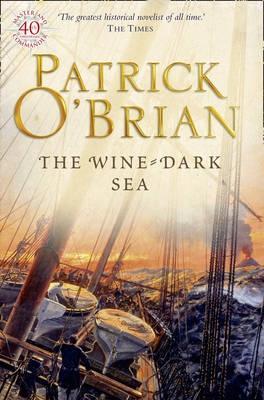
The Wine Dark Sea (Aubrey/Maturin Book #16) by Patrick O'Brian
1993 - Harper ebook - 339 pages
At the opening of a voyage filled with disaster and delight, Jack Aubrey and Stephen Maturin are in pursuit of a privateer sailing under American colours through the Great South Sea. Stephen’s objective is to set the revolutionary tinder of South America ablaze to relieve the pressure on the British government which has blundered into war with the young and uncomfortably vigorous United States. The shock and barbarity of hand-to-hand fighting are sharpened by O’Brian’s exact sense of period, his eye for landscape and his feel for a ship under sail.
So the end of Jack and Stephen's five book journey out of time finally draws to a close in a typically organic and unexpected O'Brian way. Privateers, volcanoes, pirates, whalers, disasters, uprisings and more twists and turns, packed into a 339 page book.
Fabulous, wonderful, absorbing, exciting, hilarious, marvellous, fantastic, glorious.
Words I learned whilst reading this book, among others:
- atrabilious - melancholy or irritable
- comminuted - reduced to minute particles or fragments
- supererogation - the performance of more work than duty requires
- cuddy - a stupid person
- mansuetude - meekness; gentleness
- inspissated - thicken or congeal
- asafoetida - a fetid resinous gum obtained from the roots of a herbaceous plant, used in herbal medicine
- gleet - a watery discharge from the urethra caused by gonorrhoeal infection
Had to save that one till last
Memorable Quotes:
'What is twelve sixes?' asked Jack.
'Ninety-two,' said Stephen.
Oh dear, something tells me Jack is overvaluing his prizes . . .
'Now, brother, your boat has been hooked on this age. You will be much better by yourself for a while. I am afraid I have been like a bear in a wh-ore's bed these last few days.'
. . . whilst he continues to mangle well-known phrases and sayings
-
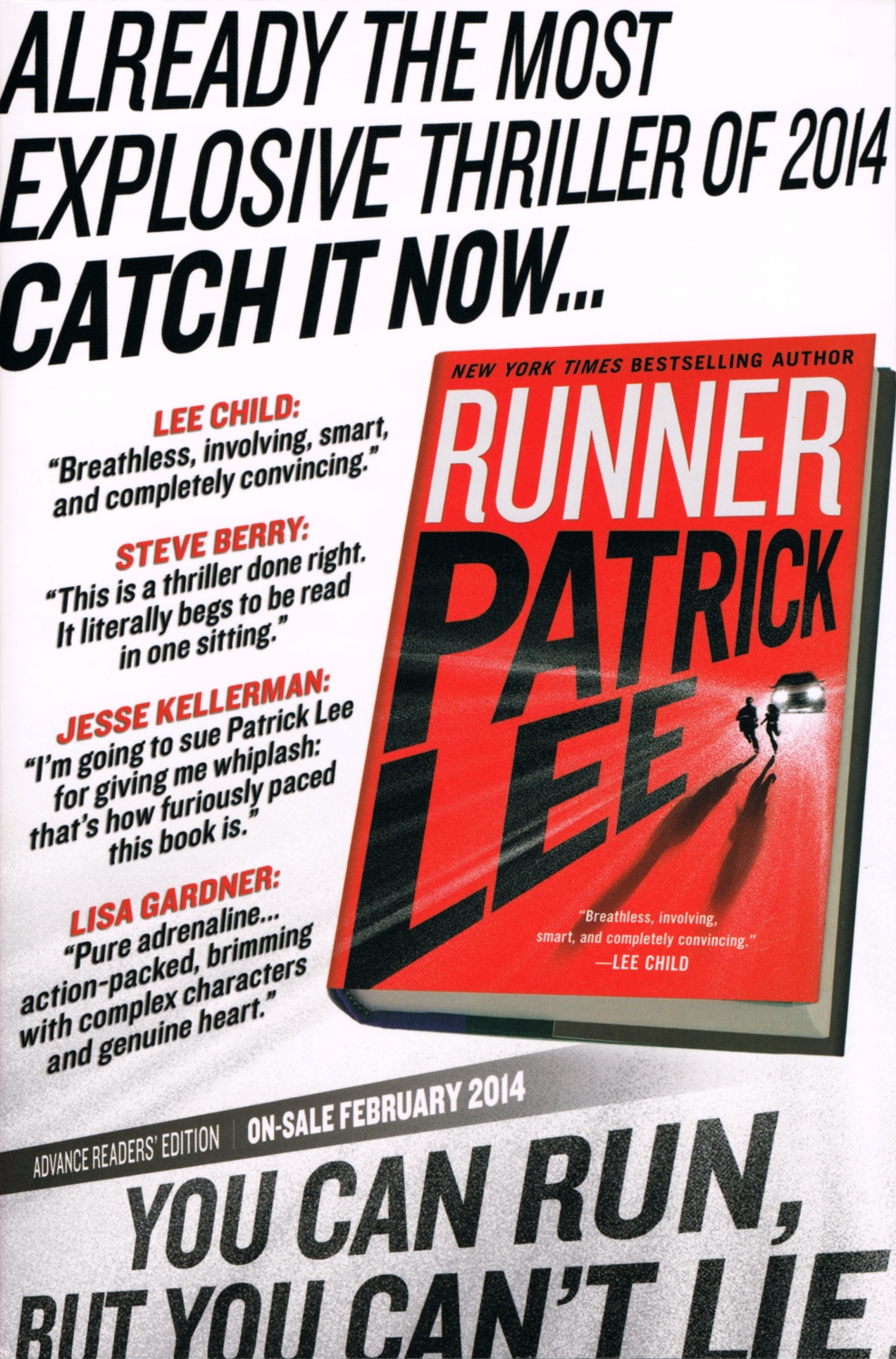
I read this one last year and it's the best thriller I've read in a long time:
It's reasonably short (326 pages), fast-paced, and really, really exciting
-
well that got my attention! Has gone on the wish-list!
The first book, The Reality Dysfunction, is 99p on Kindle at the moment
Might be worth trying the sample first, just to see if you like it, though


Jonathan Strange and Mr Norrell by Susanna Clarke
in Horror / Fantasy / SF
Posted
I enjoyed it. They could never convey on-screen what I thought made the book so special - i.e. the writing style, the footnotes etc - but as a straightforward adaptation it seemed pretty faithful to the main thrust of the story. And Eddie Marsan is brilliant, as usual